
After having eaten a good burger and beer lunch downtown, and generally shooting the shit about exploring after our run at the Industrial Brownhoist, we stepped back out into the cold, and wheeled upriver a bit to the foot of 41st Street, where the ruins of the “Alkali” allegedly lay buried amongst the trees. One thing I was somewhat bummed about though was the fact that Phoenix Antiques (Raymond Nagy’s shop) was apparently no more. The storefront seemed to be occupied by a coffee shop, meaning that our hopes of getting a sneak peek down into the Bay City “catacombs,” better known as “Hell’s Half Mile,” were pretty much kiboshed. Oh well.
NOTE: The “catacombs” are explained in the appendix at the bottom of this page.
We were not sure where exactly to look for the “Alkali,” or even how much there actually was back here to see. So we set out on a wide circling path hoping to hit the back of the ruins area first. We ended up overshooting, big time. We passed a rope swing deep in the woods, made out of an old hawser line from a ship mooring, hanging from a tree. From there we made a cut through to the riverfront again, so that we could get our bearings back and try to find these damn ruins. We had no idea how much there were or how extensive, but we did know vaguely that they were near the waterfront.

We kept finding a seemingly endless bed of busted up stones under the forest floor that popped up in piles here and there, appearing to have been the sandstone ruins of what once stood here. But we just could not pinpoint the damn place, and had to keep wandering at random. There were all kinds of trails through these woods, and at one point we came across two young kids wasting time doing nothing in particular (i.e., smacking bottles into the river with tree branches).

These pieces of rubble we kept finding were so intriguing because it seemed that everywhere a piece of it stuck up out of the ground, it had been carved on by local kids writing their names and initials and such into them. Seemed like a lot of work; I admired them for their tenacity, yet I still puzzled as to what structure/s these stones could have once been part of. Judging by the sheer amount of this rubble strewn through the woods, the Alkali must’ve been a hell of a complex. Something else that was nagging in the backs of our minds though was the fact that some of these chunks of sandstone rubble had rebar sticking out of them. Highly unusual…and perplexing.
Another point of interest that we wandered very near without realizing, was Skull Island. This was a small islet in the river, later turned into a peninsula connected to the Alkali property by the Army Corps of Engineers, where a battle occurred during the extermination of the local Sauk tribe by the other Anishinaabe tribes. Many pottery shards and flint tools can be found, according to Ray Nagy. The whole of the Saginaw River was in fact once lined with ancient burial mounds.
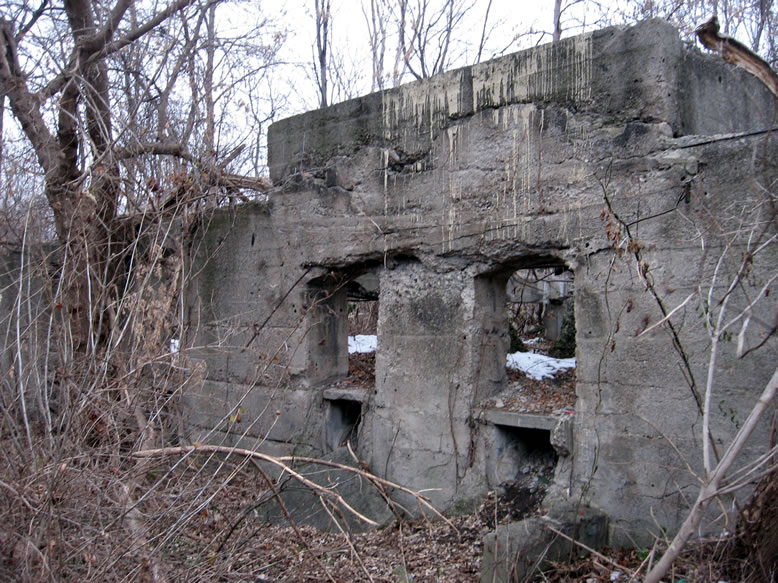
As DopeNess and I came back up toward the front of the property where we had come in at, we started to be of the opinion that we must be imminently close to the target; that we had passed up the ruins we sought right from the beginning. No matter; at least we knew now where they weren’t. And sure enough, we found them just a few yards from where we had walked in at, somehow we totally missed it because of the dense brush.


Just about the time we got there, so did the two kids we saw earlier by the river. Looked like this was a regular hangout of theirs. Despite the snow and cold weather, these two were blithely dressed in shorts and t-shirts, darting in an out amongst the huge concrete monoliths, generally making DopeNess and I look like fools in our heavy clothing.

The kids were not fazed whatsoever at our presence, and at one point they asked us if we had ever found the entrance to the “underground level.” We shrugged and said we weren’t from around here.

It was evident that there were some underground chambers here, but most were collapsed or filled in. There was a lot underfoot that we could not wholly see; the brush and snow cover hid much from our sight.

Aside from a place to spray paint and have bonfires, this was also a huge spot for paintballers. In fact it made me wish I still paintballed.

By this point, adjacent to these ruins we had found the mother lode of those sandstone chunks, and this was where the carving in them was the most prolific. DopeNess and I started postulating out loud now as to what they could possibly be, being that both of us were definitely puzzled.
This did not look like your average sandstone, and now that we had a good up close look at it, we tried to figure out what the hell its deal was. The lumps sure looked like sandstone, but were not in any regular shape, such as blocks that a building would be constructed out of, so my current theory was that they must have been some kind of byproduct; poor rock perhaps. And I wondered just how the heck these kids were carving it.

DopeNess picked up a stick trying to make a scratch on one, and to our surprise it made a huge scar on the rock with very little effort. Wow, this stuff was practically as soft as cornbread. We both rolled our eyes at our own silliness. He continued scratching, and in a few seconds had demonstrated the utter ease with which this stuff could be worked.
I picked up a chunk and lobbed it back down at another chunk. It broke apart like a dirtball. This was definitely not sandstone—it had to be casting sand, leftover from molds of some kind, or used in a kiln process, perhaps? But damn if it didn’t look just like real stone. Somebody even made it into a skull:

“The Alkali” is the local nickname for the ruins of the former North American Chemical Company (NACC), which used to operate here. Since it fell by the wayside (and its buildings subsequently carted off for scrap, most likely during the war effort in the 1940s), its foundations became overgrown and local kids played around here.

Raymond Nagy said that at least four generations of Bay City residents have grown up playing there, and that he himself had hung out there for many years. Perhaps this may have been the formative experience that sparked his interest in lost history? My development came about in the exact same way.

Could there possibly be a greater reason for leaving such ruins in our society, as opposed to incessantly demolishing everything? If not for ruins and the curious remnants of the past, where would the young Nailheds and Raymond Nagys of the world come from, without places like this to awake in our Nintendo-dulled brains the hunger for knowledge about our lost or hidden past? Or the will to go into the out-of-doors and interact with and learn from our physical environment?

If not for the gradual kindling of that sudden spark that changed my life by the time I was 23, I would have gone on in life as indifferent to my local history as the inadequate public school "social studies" classes had left me since high school, and my existence would be far more boring than it is today.
Had I never experienced that nagging curiosity, or succumbed to it and tasted the excitement of that first research discovery, I might be sitting in front of some vapid Jersey Shore bullshit right now instead of doing something to enrich my brain and those of the people around me. But the direction our society is headed in seems to want to produce empty-headed, un-curious citizens, and to demolish all traces of our past. It isn't hard to figure out why.

Perhaps those two Beavis & Butthead kids we had run into earlier whacking bottles into the river, or some of the paintball hooligans will one day eventually grow to nurture an interest in history too, because of their experience of having a safe haven here at the Alkali Ruins while growing up. Who knows, perhaps they will even become teachers.
At the very least, it's a place that they will most likely remember through their adult lives—especially when they find themselves wishing they had a similar place to escape to again, when the drudgery of middle age responsibility begins to drain them.

Anyway, back on topic.
To my mind, this site was another "long-lost-ruins" type of place, similar to the Marlborough Ruins. That is, it had transcended the phase of being merely an abandoned industrial site with a recognizable shape and a proper name, like “North American Chemical Co.,” and had gone into the literal "ruins" phase; it had been reduced to its most basic components and no longer had a recognizable shape, and was vernacularly referred to only by a nickname, e.g., “The _____ Ruins.”
But everything has a history, even if people have forgotten its name.

Formed in 1898, North American Chemical Co. was built over ruins of the former McGraw Lumber Mill. There they mined salt from brine wells, and made chlorate of potash, as well as mined coal to fire the boilers and generators in their powerplant. All on-site, according to "Time Traveler."
By 1919 they generated enough power for their operation to where they were also able to put surplus electricity back onto the grid, which they sold to Bay City, and this in fact soon became their most lucrative source of revenue. NACC did this until they closed in 1927, at which time their powerplant was bought by Consumer’s Energy. As a matter of fact, according to the city's own website, Bay City "was the first city in Michigan to adopt electricity for general street lighting purposes and the second city in the nation to have electric street cars." Today, Bay City still operates its own municipal power company.
The episode also showed Nagy looking over the broken pieces of the smokestack, which we did not find, come to think of it.

The Michigan Miner, Volumes 1-2 of 1898 refers to this plant as "The Alkali Works," a child enterprise of the United Alkali Co. of England, claiming that it "is destined to become the most important industry that has ever been established in the Saginaw Valley." The site was chosen due to the ready abundance of "cheap fuel" for its two 1,500 horsepower steam engines, which would consume an incomprehensible 200 tons of coal per day.
The plant was in full operation in 1900, and securing "good results." Chlorate of potash by the way, is what we now call Potassium Chlorate, which according to Merriam-Webster is "a crystalline salt that is used as an oxidizing agent in matches, fireworks, and explosives." It also has a medical use, especially in veterinary medicine "as a mild astringent." Potash itself is a useful mineral that has agricultural applications and occurs in areas that were once covered by inland seas. As such, Michigan has great, vast deposits of it underneath much of the Lower Peninsula—the highest quality grade of it known in the world, in fact—though it has lain forgotten and untapped until its recent rediscovery in 2013 by Western Michigan University. Renewed mining of Michigan potash was planned to be starting up in May 2014, almost as I am writing this.

The NACC also worked in other chemicals. According to the 1903 Annual Report of the Michigan Bureau of Labor and Industrial Statistics this was the only plant of its kind, "converting the waste molasses from the beet sugar factories into merchantable products. The products are mainly alcohol and cologne spirits, the refuse being used from which to manufacture fertilizers."
Anyone who has spent any time in Bay City knows that one of its major industries is beet sugar production, and has most likely smelled that pungent beet pulm odor that often dominates the air and gives the city one of its defining hallmarks. In fact, seeing the ruins of a beet sugar plant at the north end of town was on our docket for later today.

The 1903 report continues, saying that the NACC plant (which employed 50 men in 1903) produced about 1,500,000 proof gallons of alcohol per five-month cycle:
A large portion of this is sold to the United States government for use in the manufacture of smokeless gun powder. In addition to this the alcohol is used by manufacturing chemists and druggists. The plant also produces from three to six thousand tons of refuse used in the manufacture of fertilizers.By 1905, the History of Bay County, Michigan by Augustus Gansser states, 160 men were employed at the NACC plant, and it was "probably the largest concern of its kind in the world." At that time they were operating 27 brine wells of about 1,000 feet deep for manufacturing both coarse and fine salt, as well as chlorates of soda and of potash, "which go to supply the match, bleaching and fire-works industries of the country." On page 251 Gansser goes on to list "bleaches and dyes for dress goods" amongst NACC's products, "and other chemicals, the process of making which is a secret and patented."

Gansser notes that in order to procure the fuel for the NACC plant, its directors acquired the Bay Coal Mining Co., whose mines were six miles away in Frankenlust Township, because by 1904 the plant's hunger had increased to 4,700 tons of coal per month. A 2015 article by D. Laurence Rogers says that NACC also acquired the Zagelmeyer Mine, and later the Robert Gage Mine near Saginaw, which I recently explored as well.
The amount of pollution spewing out of this noxious behemoth must have been enough to stab its very own hole in the ozone.
The main building is 550 by 220 feet with numerous smaller buildings of brick. Fourteen boilers and three Coliss engines of 1,200 horse-power run the plant and consume annually 60,000 tons of coal, mostly slack. It produces 1,000 tons of the purest white salt daily by the grainer and vacuum process.

How did the NACC plant function, literally? Well as the book The Mineral Industry, Its Statistics, Technology & Trade explains,
The plant was designed by the late Dr. Hurter and by Mr. Duff, the company engineer, and it is probable that some modified form of the cell patented by Dr. Hurter, in 1893 (No. 15,396, English Patent), is used. The chief feature of this cell is that the wall serves as cathode, and that a cement lining to this wall, acts as the diaphragm. The cells are arranged one above the other in tiers, and the electrolyte flows through the vertical series of four or more cells. The weak point in the original form of cell is the absence of any provision for dealing with the hydrogen liberated at the cathodes; and this detail has no doubt been dealt with by altering the construction of the cell.And if you understand any of that, then you are a much better chemist than I. But it sounds like the Bay City plant's design may have been at least somewhat novel for its time.
In October of 2009, DopeNess and I made a return to the Alkali Ruins, along with his brother and Amy from Massachusetts. I figured the golden autumn leaves would make a nice backdrop, hence the next few photos.

By this point you may have noticed the connection to making explosives a few times, and perhaps you also put together that the time period in which the NACC was in full swing corresponded to the time period of the First World War, or the fact that the company was started and owned by British interests. A very interesting January, 2014 article recalls,
In 1915, as the existence of the British Empire was threatened by German war hordes under Kaiser Wilhelm, much of the material for explosives for the British Army was flowing out of bromine wells in Bay City, Michigan.

Again, the North American Chemical Co. was owned by United Alkali of Liverpool, England, and "boasted in 1916 that it was the largest producer of chlorates in the world." It shipped these chemicals to Liverpool "as fast as it could do so," according to Mira Wilkins. Her book, The History of Foreign Investment in the United States 1914-1945, discusses NACC and its rival, Dow Chemical.
Potassium chlorate is the basis for explosives and smoke grenades while sodium chlorate is a herbicide and used in explosives. It also was used to produce chlorine dioxide, a disinfectant, which at high concentrations is extremely dangerous and poisonous for all living organisms, and was historically used in World War I as the first gaseous chemical warfare agent.

By 1917 when the U.S. entered the war, the Army sought mustard gas for use on the battlefield, since the Germans already had it. They collaborated in secret with Dow Chemical Co. in Midland, Michigan to produce the first American mustard gas in 1918.


Today, a century later, Dow is still one of the most recognized corporate names in the world while no one remembers NACC, which had shut down completely by 1928 (except for its powerplant).

As the creepy voice-over guy in the "Time Traveler" show suggests in his monologue at the beginning of every show, "One hundred years ago, somebody stood in the very spot that you are currently inhabiting, and life was vastly different..."
Exactly 100 years ago on this spot, men dressed in knickerbockers were busily shoveling coal into furnaces and rendering chemicals that would become the gunpowder charge behind the .303 Enfield bullets fired from the rifles of Englishmen on the Western Front, to halt German advance in the "War to End All Wars."

"Why should anyone care, you ask? Well think about this, my friend: One hundred years into the future, somebody will be standing right where you are. What will life in your city look like then?"

"How much do you really know about your city?"


As we drove north of town to the other two locations across the drawbridge, the snow started to pick up quite a bit. We parked near what I believe was a boat launch, and marched directly into the tree line on the other side of some train tracks. Immediately we were amongst another bare concrete ruin.
According to the only thing DopeNess could dredge up about the property, it had once been the West Bay City Sugar Co., or at least their silos, perhaps?

The ruins consisted of basically a rectangular foundation structure with forms inside, approximately 25 yards wide and 200 yards long.

At the ends there were openings for what might have been augers or something, for moving a granular substance at the bottoms of what could have been storage bins, perhaps:

At the other end, we could see that it had filled with water and become a swamp:

Popping out of this copse of trees we crossed a field to what DopeNess indicated was the L. Surath & Sons salvage company:

I guess it was maybe a scrap metal operation, where railcars could pull in and be filled with scrap from the second floor, it appeared?

While we were inside, the full wrath of the snow flurry unfolded, and we began to think about road conditions for our respective trips back home. There was not a helluva lot to see here, so we decided to split a little early and call it a fairly productive day.
I recently came across a book entitled Bay City, 1900-1940, in Vintage Postcards, by Leon Katzinger, that features a postcard of West Bay City Sugar, saying it sits near the Belinda Street Bridge, and that it opened in about 1900. The photo shows a long concrete building that would definitely seem to mirror the ruins we saw. Furthermore, it stated that the last intact building of the West Bay City Sugar Co. had been reused by the "Surath Scrap Yard." I'd say that it's a pretty good bet DopeNess had our ruins identified correctly. This building we were walking around in also originally been part of the sugar mill.

According to an article in the Bay Journal, West Bay City Sugar Co. drew beets from about 4,000 acres farmed under contract in 1901. At that time, about 400-500 tons of beets were delivered daily by farmers' wagons. There were two other major sugar factories in the city at the time, the Michigan Sugar Co., and the Bay City Sugar Co., and it was noted that these companies have the advantage of getting their coal mined within a mile from their factories, meaning "a great savings in freight on fuel."
A c.1927 book entitled Michigan's Thirty Seven Million Acres of Diamonds said that of Michigan's sixteen beet sugar factories with a total output of 1,500 tons per day, Bay City's production was greater than that of any other city in the world.
References:
"Time Traveler," Episode 005, by Raymond Nagy, G.C. Kirkland
The Michigan Miner, Vols. 1-2, 1898; pg. 19
The Mineral Industry, Its Statistics, Technology & Trade; pg. 486
http://www.mlive.com/news/kalamazoo/index.ssf/2013/09/wmu_geologists_and_private_fir.html
http://www.michigan.gov/documents/deq/deq-ogs-STATE_POTASH_429237_7.pdf
1903 Annual Report of the Michigan Bureau of Labor and Industrial Statistics
History of Bay County, Michigan, by Augustus Gansser
http://www.baycitymi.org/departments/electric-department/item/140-history
http://www.mybaycity.com/scripts/p3_v2/P3V3-0200.cfm?P3_ArticleID=8747
http://bay-journal.com/bay/1he/writings/saginawvalley-indians-bcj1865.html
Bay City, 1900-1940, in Vintage Postcards, by Leon Katzinger; pg. 35
Michigan's Thirty Seven Million Acres of Diamonds, by Clyde L. Newnom
"From Boom to Bust, Bay City's British Explosives Factory," by D. Laurence Rogers, Chronicle, Vol. 38, No. 3 (Fall 2015), p. 14-16
"From Boom to Bust, Bay City's British Explosives Factory," by D. Laurence Rogers, Chronicle, Vol. 38, No. 3 (Fall 2015), p. 14-16
* * *
Further reading on the Bay City “Catacombs”:
Hell’s Half Mile….As far From Heaven as One Might Expect
By Bill Pavlov
New York has the Great White Way, Chicago has it’s Magnificent Mile and Bay City has its very own Hell’s Half Mile. Upon first hearing that title, one may wonder why this particular area was given this seemingly unflattering label. This bustling business district which started at the foot of Washington Ave, running west through Saginaw and Water St. and then north past Center Ave. was more notorious than most areas in Bay City ever were, and certainly lived up to its name. This unique spot which is ubiquitous reputation, offers a rather colorful and illustrious history filled with unruly behavior, rowdiness and all the bawdiness one could imagine for Bay City’s earlier inhabitants.
Primarily, the name derives from the temptations offered by the allure of the dozens of saloons…some of which were mere facades for the houses of ill repute and gambling houses. In addition, the several small experimental theaters dotted throughout this area provided bawdy entertainment that would shock even modern day theatre patrons. During this era from approximately 1870 through the early 1900’s, there were no regulations to prohibit prostitution and lascivious entertainment and quite frankly such behavior was encouraged by law enforcement officials and business owners for the increased revenues it offered to the city. Not only would the law enforcement officials of that time “look the other way”, but some would also engage in the business aspect of the industry. It was documented that even the Town Marshal of that era, D.H. McRaney, owned a brothel where it was reported the spent most of his time.
With the throngs of lumbermen who regularly traveled through town, the saloons offered a place where the workers could get to know the city, feel grounded, and catch up on current news and events of that time. Brawls would occur regularly which would result in an occasional homicide…sometimes on average of one a week.
For convenience, there was this amazing intricate underground network of hallways and catacombs that would traverse from taverns, shops, and houses of ill-repute. These “routes” would provide easy access for those patrons who needed discreet access from saloon to brothel and back. It also provided for safe passage for those drunken and raucous souls who may otherwise have encountered a brawl were this “alternate” route not available. Additionally, some of the more inebriated patrons would conveniently rent out spaces to sleep in these catacombs for 5 cents a night. Hints of these underground access ways still exist, and are buried under streets and sidewalks. Evidence of the catacombs can be found in some of the current stores now occupying these buildings. Other remnants have been revealed during building projects. Recently during the construction of the brownstone condominiums along Water Street the mysterious “Underground City” was unearthed, revealing intact storefronts, passageways and streets. Due to the extensive preservation that would be required to excavate and restore, it was decided to re-bury this interesting piece of Bay City history…ultimately leaving its past buried deep…as deep as the reputation of Hell’s Half Mile has in Bay City’s history.
Next time you stroll down this area, take a moment to imagine the way things were…gas lights illuminating the walkways, hidden underground routes, saloons filled to the brim with patrons enjoying conversation and a brew, people scurrying to the next “jaw dropping” theatre venue…and then think of the thousands of stories that could be told…and how it’s probably better for Bay City’s reputation that they aren’t!
From http://www.kingfishbaycity.com/history.htm, which is now a broken link:
Why was Water Street so dangerous, you ask? Well, consider that around May 1st each year upwards of 5,000 of the roughest and toughest lumberjacks would descend on this six block area to party it up and unwind after being cooped up in the woods chopping down trees 12 hours a day for eight or nine months. The loggers would be flush with winter earnings of $75 to $200 or more. These men hadn't had a bath, downed a drink, or seen a woman for six to eight months, so they were really ready for action.
The Wolverton Hotel as on the site of the Kingfish in the 1800's and was considered the finest hostelry in northern Michigan, along with the Campbell House across the street, now the Bay City Antiques Center. The corner of Third and Water was the heart of what was know as "Hell’s Half Mile", notorious for its 37 saloons, 26 hotels, and several liquor stores all within a six block area. About 300 prostitutes, the cigar-smoking "Belles of Water Street", also reputedly populated the area. The Third Street Bridge Block, from Water to the river on Third, was known as the Catacombs for its seven saloons on several levels, sin cribs in the basement, the rowdy Steamboat Saloon on the main floor and a wild variety theater with a wine room and private compartments on the top floor. Activities there were suited to the vilest and most depraved tastes and moral corruption those even more than 100 years later it can scarcely be hinted at.
Tunnels ran throughout the streets on "Hell’s Half Mile" and could be entered at the river level where several dives were located, handy for ship crewmen, dock wollopers, longshoremen, and others to grab a quick nip between jobs loading lumber or supplies. The most notorious sin dens included the Miki O'Brien’s, The Walhalla, and the Idaho Saloon on Water between Fourth and Fifth, The Do Drop Inn on Water at Center, The Red Light on Fourth between Saginaw and Water, The Blood Tub upriver at Garfield and 12th, and the infamous George Cook's on Third near Saginaw. So many river hogs once jammed Cook’s that the floor caved in. The injured were removed and planks were quickly placed across the span so the carousing could continue without let-up. A distraught prostitute, Lizzie Galligan, killed herself with a 50-cent dose of morphine in the Idaho, languishing for hours and dying slowly as customers, including two doctors who tried to save her, watched. One of the best-known houses of prostitution was part of the Catacombs and was called "Holy Old Mackinaw". From there a trap door deposited unfortunate lumberjacks into the river after they had been drugged and robbed.
Although Michigan was "dry" from 1855 to 1875, saloons flourished and drunkenness was common. There were 559 arrests for drunkenness in one year, 1873-1874, and only 9 for operators of illegal saloons. Infamous tippler Johnny "Brick" Thomas was arrested 299 times during his drinking career. Guys like Paddy the Racker, Guzzling Grant Jacobs, and Paddy the Marchall D.M. McCraney was charged with drunkenness, indecent exposure, blackmail and keeping a lewd house. At 6'4" and 250 pounds, McCraney and his 12 contract thugs, err patrolmen, extracted $1 a day "protection" from the saloonkeepers. Those who didn't pay were raided. Besides the legalized extortion, bands of thieves and pickpockets descended upon the district when the drive was in.
The end of prohibition in 1875 was a cause for celebration, although activities didn't change much in Bay City. When a liquor dealer operating from Hawkins & Co. dock next door sponsored a bilious cruise to Wenonah Beach, the crew aboard got rowdier than usual. Huge French Canadian timber boss Fabian "Joe" Fournier conquered all in shipboard brawls but his comeuppance as he strode down the gangplank at the end of the violent cruise. His immortal last words came when asked where he was going and Fournier replied "to hell". He may not have been far from wrong. Ex-con Adolphus "Blinky" Robertson, a stone mason from Saginaw, knocked fabled fighting Fournier into the pages of history with a foul blow from a ship carpenter’s mallet. News reports and campfire tales built Fournier into a legendary character, Paul Bunyan, America’s best-loved folk hero.
All of this nefarious activity was gradually snuffed out in the late 1870’s when the food folks of Bay City hired a strong-arm police force headed by burly Civil War veteran Nathaniel Murphy and the temperance preachers and Red Ribbon ladies took over. Some 2,500 formerly drunken lumberjacks "took the pledge", 485 in one week alone. Sale of liquor to minors and habitual drunkenness was forbidden and saloons were required to close Sundays. “Dare to Do Right” was the slogan. A few hostile saloonkeepers tied red ribbons on dogs to show their contempt, but law and order prevailed.


